Wednesday, June 19, 2013

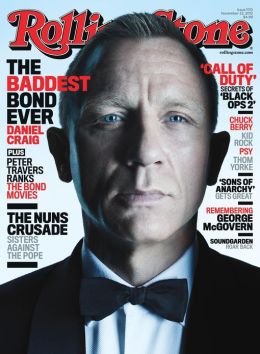
"Hoop Dreams 2012"; Rolling Stone


Bravo Rolling Stone! I never thought I would write those words but I repeat, bravo! Thanks you for serving a powerful critique of the NBA!

Matt Taibbi’s “Hoop Dreams 2012” justifies my distaste for the Miami Heat and Los Angeles Lakers with picturesque metaphors and logical reasoning.  I can like Steve Nash and not know where Denver is on a map and still hope the Nuggets to crush California’s powerhouse. I can respect every other morally upstanding team in the league, cheer for them as if they are my “home team,” and not feel pink-shirt guilt. And as far-fetched having a new champion seems, hope remains. It is possible.

Dwayne Wade, left, and Kobe Bryant

If Rolling Stone’s sold jerseys, I would sport Taibbi’s. Succinctly, he conveys immense disgust for the moneymaking machine leading NBA teams morphed into over the past 20 years. He captures attention with his paragraph-long lead sentence, and he holds that attention with efficient, effective writing. Slam-dunk!

"Border Showdown"; Outside


The first words I associate with national parks: serene, beautiful, vacation, American. Violent, dangerous, drug wars, deaths do not make the list until I read Bruce Barcott’s “Border Showdown,” featured in Outside's February 2003 release.

Organ Pipe Cactus National Monument is a 330,690-acre national park in Arizona that includes 30-miles of Mexican border. It may be a “swath of beautiful, heat-blasted Sonoran Desert,” but the park has, as Kelly Clarkson would say, a dark side, which Barcott’s descriptive, active language effectively conveys throughout his article.

Imagine six men protecting an area “twice the size of greater New York” with revolvers. Now add an annual “onslaught of 300,000 illegal immigrants and drug smugglers equipped with automatic weapons, night-vision goggles and 4X4 SUVs” to the mix. No wonder the park made the 2002 and 2003 top 10 most dangerous national parks lists, and was closed to the public for 10 years, reopening in 2012.

“Border Showdown” is not my favorite article; it would not make my must read list, but it has many commendable assets. Barcott portrays the park ranger experience in terms people can relate to. He describes Organ Pipe Cactus National Monument in terms Americans can visualize. More than that, he takes an iconic lifestyle—working as a park ranger—and casts it in an uncommon light. I often associate park rangers as living the dream, strolling through days of interaction with tourists and elementary-aged children on fieldtrips, but clearly, the job is not always a walk in the park. 

Tuesday, June 18, 2013

"In the Line of Fire"; Sports Illustrated


Like a powerful direct kick, Grant Wahl’s profile of soccer player Hérculez Gómez, “In the Line of Fire,” soars over behind-the-scenes NCAA basketball stories and NFL round-up features before softly landing in readers’ hearts. I commend Sports Illustrated for featuring this long shot article in its Feb. 4, 2013, edition.

The topic has two knocks against it. First, soccer is an underdog professional sport in the United States, especially in early February when the NFL hits its height, the NBA finds its mid-season swagger and college basketball swiftly creeps toward pinnacle play. Second, Mexico, the story’s setting, is an underdog country many Americans disregard; but unlike soccer, two fouls do not equate to story ejections (or rejections) in the publishing world, and this piece has a saving grace: it needs to be told.

Wahl knows how to tell it. He details Gómez’s unconventional comeback while simultaneously providing context about Mexico’s political corruption and dangerous cities. Department of State warnings about travel to Mexico may be common knowledge (you can read one in the story deck), but I doubt many SI readers know Torreón, a city in central Mexico, ranks the “seventh-most dangerous city in the world.” I doubt many know Torreón is a city. Shamefully ignorant, I had no idea 60,000 people have died since the Mexican drug war kicked off in 2007 and I never expected learning that from reading SI.

Addiction to political outlets and international news is not as potent as the sports obsession in the U.S. Wahl takes a serious issue—the “gruesome parade of dead bodies” just south of the U.S.—and presents it in a palatable portion intermixed with the sugar of sport. He uses strong descriptive phrases to detail the irony of Gómez finding success within Mexico’s borders. There are thousands of stories about Mexicans escaping to the U.S. to start better lives. How many plots detail Mexicans escaping to the U.S., then returning to Mexico for successes? I know one: Gómez’s. The man transformed from a financially struggling “MLS afterthought” into a “Mexican scoring champion.”
Gómez showing off his signature post-goal pose.

“In the Line of Fire” gains momentum immediately with its introductory anecdote, which details Gómez’s frightful drive home. It nets a goal with its concluding reflection on Gómez’s bright future and impending World Cup qualifying play.  
Tuesday, June 11, 2013

"Window or Aisle?: Beth Deloria"; U.S. Airways Magazine


Unique from the magazines I previously analyzed, U.S. Airways Magazine is clearly a publicity tactic the company uses to promote their primary business entity: U.S. Airways. The January 2013 edition’s column “Window or Aisle?” featured Beth Deloria, an avid runner, a philanthropic-focused professional and a frequent U.S. Airways flier.

With the exception of the deck and the questions, the entire article is Deloria’s words. There is no paraphrasing; it is strictly a word-for-word transcription of her interview. She provides eloquent, thoughtful responses to terse, under-developed questions.


Two questions are closed questions. Potentially Deloria could have provided one-word answers to two other questions. Out of the six questions, these are not good odds. Phrased differently, the article could have been insightful; however, that is not U.S. Airways goal. Their goal is to promote their airline. The closing questions (“Why U.S. Airways?”) successfully did just that and resulted in an unmemorable article. 

"Funny Feeling"; The Improper Bostonian


Flipping through The Improper Bostonian’s 2013 Chefs Issue, I get a “Funny Feeling” when I stumble upon a nail polish short sandwiched between articles about exotic wines and local delicacies. Is it real? Did I truly find an article about a fashion product preschoolers enjoy in a sophisticated adult magazine? You bet, and Christina Giannopoulos nailed the topic.

Giannopoulos’ fun, pun-heavy, metaphor-ridden writing adds a mature feel to an often tween-focused topic. The article remains consistent with the Chefs Issue’s theme—food—comparing Ciaté nail polish to “caviar.” In 11 sentences, she alludes to two trending icons (Mariah Carey and Kate Middleton), describes three separate nail polishes and details their effect and how to use them.
 “Funny Feeling” is a rich article on a mundane topic. If political journalists wrote about as colorfully and succinctly as Giannopoulos, more Americans would know about the ongoing Turkish turbulence and Tennessee’s recent religious tensions.

Friday, June 7, 2013

"Vacation Your Way to Better Health"; Arrive


Efficiency versus effectiveness. What is the difference? Michael Hammett’s article “Vacation Your Way to Better Health” featured in Arrive’s July/August 2012 publication is a solid example.

In fewer than 300 words, Hammett efficiently conveys advice—take more vacations to improve health—and why people should follow his suggestion. He fluidly blends his lede and nut graf into one paragraph and offers an ‘aha!’ moment. Hammett lists commitments we should be making to lead healthy lives, such as eating nutritiously and exercising regularly. He then suggests adding vacations to the list. My first thought: “That’s it?”

Although an easy 30-second read with a strong introduction, the second half of Hammett’s article loses effectiveness. Effectiveness includes both how and what you present.

The freedom of vacation
Two academic studies strengthen Hammett’s argument. Ph.D. Researcher Brooks B. Gump, provides disturbing statistics. Citing him validates the article, but referencing expedia.com concerns me. I question expedia.com’s motives for conducting their survey and the data procured. I question Arrive’s corporate relationship with expedia.com.

Quotes from Gump charge this piece but the concluding quotation does nothing to forward the argument. It reiterates the previous paragraph and just ends. Hammett could have created a stronger, original concluding sentence or cut the last two paragraphs and concluded with Gump’s quote in the third last paragraph. 

"The Audacity of Hope"; Howler


I am officially confused. What “audacity” Gwendolyn Oxenham has to accurately describe the United States women’s national soccer team’s metamorphosis from the 1999 team's for-the-greater-cause mentality to the I-am-the-greater-cause publicity machine it is today, while simultaneously casting its current personalities as needed to succeed. How dare she make me reconsider my loath of brash Hope Solo!


U.S. 1999 World Cup team
Oxenham (a novelist and former collegiate soccer player) briefly overviews the history of U.S. women’s soccer in her article, “The Audacity of Hope,” featured in Howler’s Fall 2012 edition, but predominantly she contrasts Solo’s recent antics with the 1999 national team’s behavior. The strong introductory anecdote contrasting the titles of Mia Hamm’s and Solo’s autobiographies gives the article an objective feel. Oxenham immediately follows the initial punch with an efficient nut graf that states there are more differences between past and current players, “the legendary 1999 team and the legends of today,” than just the ‘me’ versus ‘us’ attitude.

Hope flying solo
Quantitative facts sprinkle the article, but the diverse, obscure anecdotes are the article’s backbone. True women’s soccer fans would drool over the rich content. Oxenham’s syntax reflects the personalities she describes. For example, when she describes Solo’s contempt for the “old team,” I see Solo’s disgusted face and hear her whiny voice complaining about Hamm’s fame.


Oxenham annoys me. She solidly explains Solo’s personality and behavior. She emphasizes players’ personalities and behaviors reflect society’s expectations. Solo succeeds on the pitch because of her confidence and competitiveness. Off the field, her pompousness and cattiness draw attention. Coach Anson Dorrance saying it is worth dealing with her antics to have the “greatest female goalkeeper in history” in the net solidifies why the U.S. needs Solo. I really do not want to admit he is right. 

Thursday, May 30, 2013

"Running Naked"; Runner's World

Perusing Runner’s World Magazine’s homepage, I was immediately drawn to two words: “Running Naked.” My first thought: Where in the United States can you run without clothes? Naked is an ambiguous word commonly associated with stripping off clothes. In all contexts, only the action—removing something—remains constant; the object changes.

Kristin Armstrong
Kristin Armstrong’s May 23 Mile Markers column, “Running Naked,” is a compelling read from title to end. As I read the emotionally deep article, I quickly felt shamed by my initial immature thoughts.  When ordered by a coach to run without a watch, to run “naked,” Armstrong realized she already does, but for her being naked has nothing to do with taking off a watch. Every time she runs, she lets her thoughts wander and she explores a different depth of her emotions.

I relate to Armstrong’s experience and admire her honesty and apt description. Nothing compares to a challenging run. Both physically and mentally taxing, running pushes me to the edge. As my legs churn and my breath labors, my mind slows and clears. There is a terrifying moment when I realize, no matter how fast I go I cannot outrun life’s problems or my feelings. That is what Armstrong describes.

"Try running naked."
Stripping emotionally is scarier than doing so physically. It is comforting to read Armstrong’s concurring opinion. She humanizes her experiences and her feelings, describing them in a universally relevant manner. The approximately 500-word article concludes with a hopeful tone and a humorous innuendo: “Try running naked. … Strip off your burdens, fears and heartache, and let it all hang out.” This powerful column is one I will save for a rough day when I need a reminder I am not alone as I tie up my joggers, strip down my thoughts and go for a run.